
Outdoor Lighting and British Weather: IP Ratings Explained
A porch light that shrugs off a drizzly June evening is not the same fitting as a wall light that faces three months of horizontal rain off the North Sea. Most garden lighting sold in the UK is described as weatherproof, but that word means very little until you find the two digits printed after the letters IP. Those digits decide whether a light is still working in five years or quietly full of water by its second winter.
What an IP rating actually tells you
IP stands for Ingress Protection. The rating comes from an international standard, IEC 60529, published in the UK as BS EN 60529, and it uses two digits. The first covers solid objects, including dust; the second covers water.
On the solid side, 0 is no protection, 1 covers objects over 50mm, 2 over 12.5mm, 3 over 2.5mm, 4 over 1mm, 5 is dust protected and 6 is dust tight. So an IP65 fitting is dust tight and protected against water jets, while IP44 resists solid objects over 1mm and splashing water.
A higher number is not automatically the better buy. A fully sealed IP68 unit can trap heat, and some designs suffer internal condensation with nowhere for the moisture to go. Sealed fittings can also be awkward to re-lamp or to have their driver replaced.
The water digits, translated for a British garden
- IPX0 — no water protection at all. Indoors only.
- IPX1 and IPX2 — dripping water, including drips falling on a fitting tilted up to 15 degrees.
- IPX3 — spray at up to 60 degrees from vertical. Fine under a deep porch roof.
- IPX4 — splashing from any direction. The realistic minimum for outdoor use.
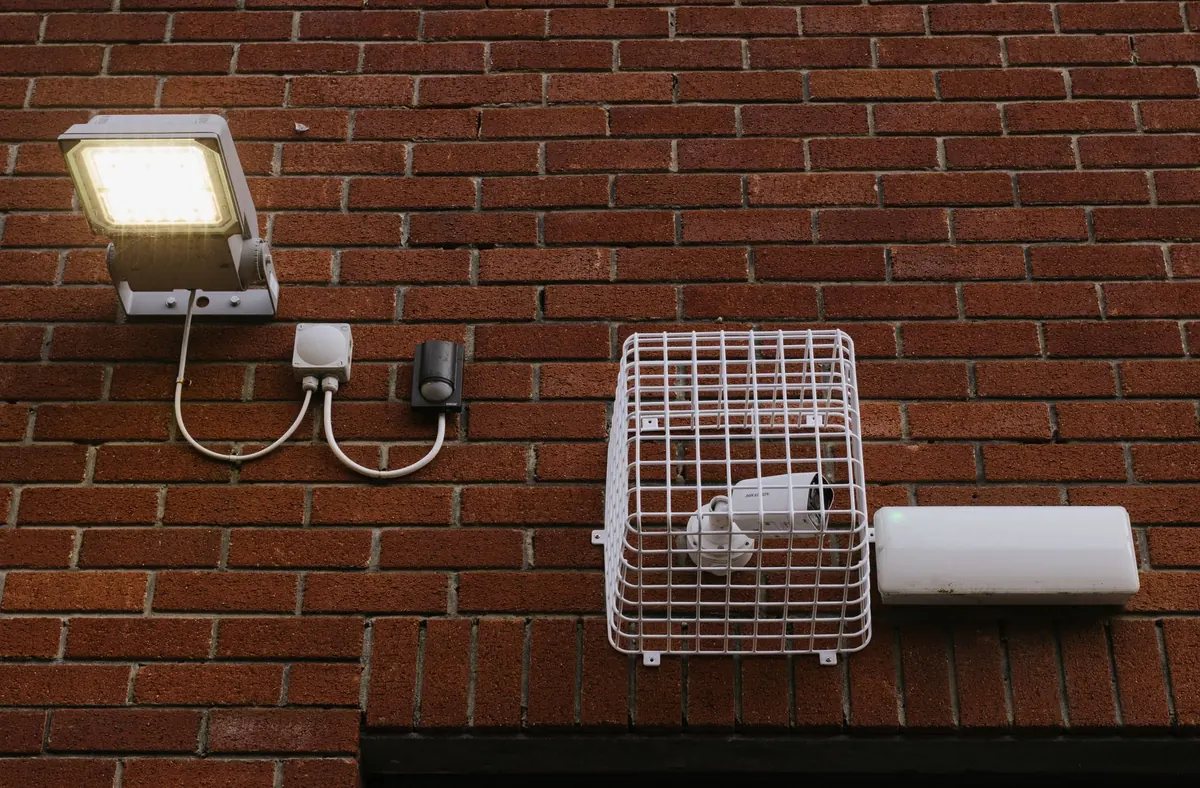
- IPX5 — water jets from a 6.3mm nozzle. This is the honest match for driving rain on an exposed wall.
- IPX6 — powerful jets from a 12.5mm nozzle, including the occasional hosepipe aimed at a patio.
- IPX7 — temporary immersion in up to a metre of water for 30 minutes.
- IPX8 — continuous immersion, to a depth agreed with the manufacturer.
Jet ratings and immersion ratings matter for different reasons. Rain driven hard against a gable end behaves like a jet, not a splash. A light buried in a clay border behaves like something sitting in a puddle, which is immersion territory. If a fitting will ever stand in water, splash protection will not do.
Which rating suits which position
- Under a deep porch or eaves overhang: IP44 is usually enough.
- Exposed wall lights on a gable, fence or open corner: IP65.
- Spike lights and bollards in a border: IP65 or IP66.
- Recessed deck and step lights: IP67, particularly at the bottom of steps where water collects.
- Buried uplighters: IP67 as a minimum, IP68 in heavy clay or where the water table sits high.
- Pond and water feature lights: IP68, with the driver kept well away from the water.
Treat these as minimums rather than targets. Choosing IP65 where IP44 would have coped costs a little more and removes a whole category of future annoyance.
What the IP rating does not cover
This is where most garden lighting quietly fails. The test assesses water and dust ingress on a new sample. It says nothing about:
- Salt corrosion of fixings, screws and housings
- UV degradation of plastic lenses and cable sheathing
- Frost damage and repeated freeze-thaw cycles
- Impact resistance, which is covered separately by an IK rating
- Whether the cable gland and connector are as well sealed as the fitting
- How the rubber gaskets will behave after three summers of sun
A fitting can be genuinely IP65 and still be the wrong choice for a coastal garden, because the failure will be corrosion rather than water. Equally, a cheap gasket will harden and shrink over time, and the IP65 that was true in the factory may not be true in year four.
Coastal air is a different problem
Within range of sea spray, salt settles on every surface and starts work on any bare metal it finds. Look for 316 marine-grade stainless steel, well powder-coated aluminium, solid brass, or a high-quality UV-stable composite. Standard 304 stainless and painted mild steel both struggle near the coast, and mixed metals in the same fitting can corrode each other.
A simple routine helps: rinse exposed fittings with fresh water two or three times a year, and again after winter storms. It takes ten minutes and noticeably extends the life of the housing and the fixings.
Frost, drainage and the small details
Frost rarely kills a light directly. It kills the joint that was already holding water. A few habits prevent most of it.
- Run cables with a drip loop so water runs off the cable rather than into the fitting.
- Point cable entries downwards or sideways, never upwards.
- Use IP68 gel-filled connectors instead of a terminal block inside a plastic bag.
- Avoid fittings with flat tops that collect rain; check that drainage holes are clear.
- Keep transformers and drivers indoors, in a shed, or in a proper IP-rated enclosure above ground — not buried in a flowerbed.
- Check gaskets and seals each spring, and replace any that have gone brittle or flat.
Before you buy: a quick checklist
Decide where the light will live, then work backwards. Sheltered porch: IP44. Exposed wall: IP65. Ground spike: IP65 or above. Buried or underwater: IP67 to IP68. Near the coast: add marine-grade materials to the list. Then check the small print — the gland, the connector and the driver all need to match the fitting.
Buy for the worst week of the year rather than the average one, and your garden lighting will still be doing its job when the storms arrive.
Photo: wal_172619 / Pixabay