Table Lamp Buying Checklist for Small Bedside Tables

Bedside tables are rarely as generous as the ones in showroom photographs. Many are 30–40cm wide and barely deeper, wedged between the bed frame and a wardrobe or wall, with just enough room for a mug, a phone and a paperback. That changes what a table lamp has to do. It has to light the page in your hand, stay upright when you fumble for a glass of water in the dark, and not crowd the one corner of the room that is genuinely yours. Before you fall for a shape or a finish, work through the measurements and the practical details below.
Measure the table, not the room
Start with the usable top rather than the advertised size. A table described as 30cm deep may give you closer to 22cm of clear surface once you allow for a skirting board, a cable exit at the back and the lip of a drawer below. Round tables are worse than they look, because a circular top loses usable area at the edges where a lamp base would sit.
Two more measurements are worth taking while you have the tape out. First, the height of the tabletop relative to the mattress. If the two are roughly level, the lamp sits lower than you picture, and you will want extra height in the lamp itself. If the table stands proud of the mattress, you can afford a shorter model. Second, the position of your nearest wall socket. It decides how the cable will run and, more importantly, what kind of switch you can reasonably reach.
Base diameter: the footprint test
As a working rule, keep the base to roughly half the depth of the tabletop. On a 30cm-deep table, that means looking at bases between about 12cm and 16cm across. Leave a couple of centimetres of clear wood or laminate on every side, not just the front. A base that touches the wall behind it will rattle every time you nudge the shade.
Weight matters as much as width. A narrow table is easy to tip, so favour a lamp with a heavy base and a low centre of gravity — a stout ceramic column or a solid metal foot rather than a thin stem on a small disc. If the lamp has a rectangular or wedge-shaped base, it can often be pushed into a back corner, which frees up more of the front of the table for actual bedside clutter. Felt pads underneath are a small thing that saves your furniture and stops the lamp sliding when you reach past it.
Shade width and overall height
The shade is usually the widest part of the lamp, which makes it the part most likely to cause trouble. A shade roughly as wide as the base, or a little wider, tends to look balanced. On a narrow table, cap the overhang: if the shade extends more than about 2–3cm past the table edge, you will catch it with your elbow, and it will lean into the gap between the table and the bed.
Shape changes the light as well as the silhouette. A tapered shade, wider at the bottom, pushes light downwards onto a book and upwards for a soft wash on the wall. A straight-sided drum spreads light more evenly in every direction, including sideways into the face of whoever is sleeping next to you. In a small bedroom with two sleepers, a downward-leaning shape is usually the kinder choice.
For height, most bedside lamps land somewhere between 40cm and 55cm tall, but the exact figure depends on the table. The test that matters is where the bottom rim of the shade falls when you are sitting up in bed.
Sit on the bed at night, hold your book at reading height, and check the shade. If you can see the bulb, the lamp is too short for that table — or the table is too low for that lamp.
Switch access: the two-in-the-morning test
A switch you cannot find without sitting up is the wrong switch. On a narrow table, the base is often pushed close to the wall, so a switch mounted on the back or side of the base can be awkward. An inline rocker switch on the cable, sitting perhaps 20–30cm from the base, is the most forgiving option: it needs no clearance around the lamp and you can find it by touch.
Other arrangements suit different habits. A switch on the front of the base works well if you have a hand's width of space in front of the lamp. Touch dimmers divide opinion — simple to use, but easy to trigger while dusting. A smart plug or a lamp with a remote control removes the reach entirely, though it adds an app, a plug and another thing to charge or replace. Whichever you choose, keep the cable out of any walkway between the bed and the door, and avoid overloading a multi-way adaptor; if you need extra sockets fitted, that is a job for a qualified electrician.
Brightness, colour and bulbs
Lumens first, watts second
Brightness is measured in lumens, not watts, and the numbers that suit a bedside are modest. Around 200–300 lumens is comfortable for winding down with a phone or a magazine. Reading a printed page usually wants more — somewhere in the region of 400–600 lumens, aimed at the page rather than the room. If you read for long stretches and wear glasses, err towards the higher end, or choose a lamp whose shade can be angled.
Warm white after dark
Look for a colour temperature around 2700K. That warm white feels domestic in a small room; anything above roughly 3500K starts to feel like an office corridor at bedtime. A frosted or opal bulb softens the glare and hides the filament, which matters when the bulb sits close to your eyeline. If the lamp is dimmable, check that both the lamp and the bulb are rated for it — mixing an incompatible dimmer with an LED bulb is a common cause of buzzing and flicker.
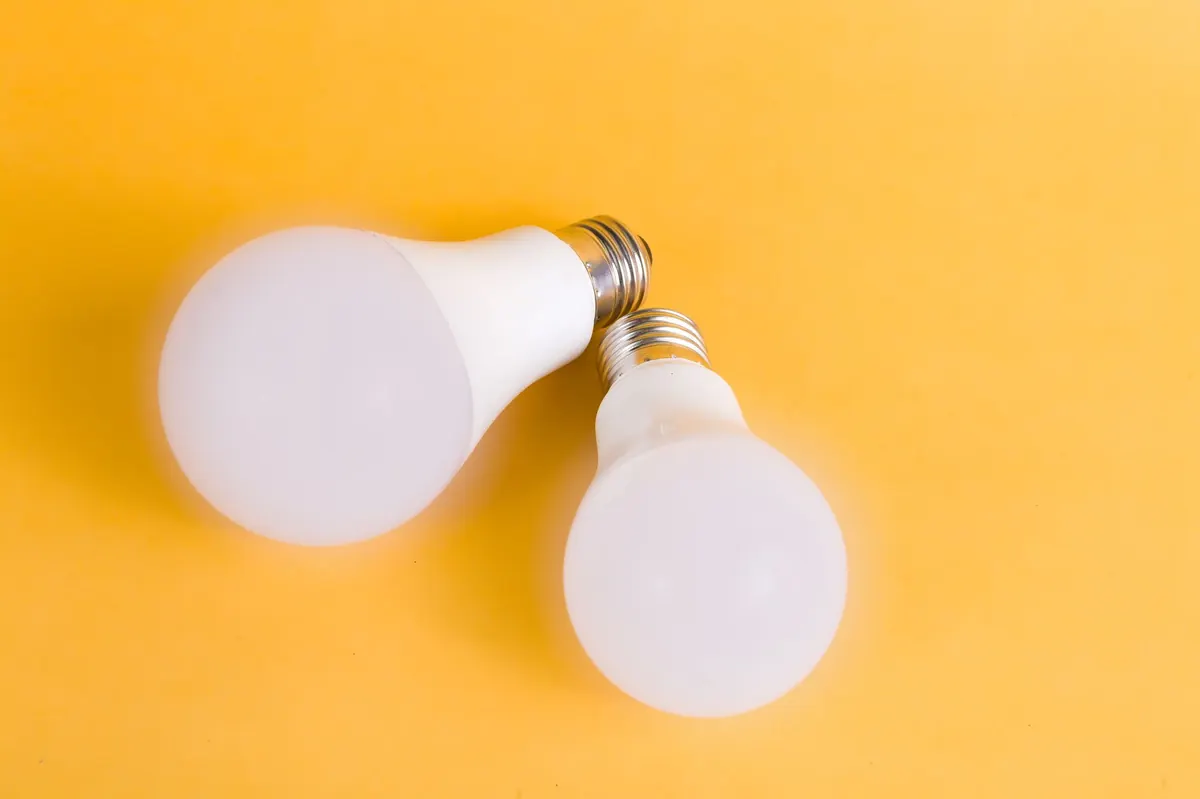
Finally, check the fitting. Small Edison screw (E14) bulbs suit slim bases; standard Edison screw (E27) gives you far more choice, but the bulb itself is bulky, so measure the shade's internal space. Integrated LED lamps look neat but may not have a replaceable bulb, so weigh up how long you expect to keep it.
The quick checklist
- Base: no more than about half the table's depth, sitting clear of the wall.
- Stability: heavy base, low centre of gravity, felt pads underneath.
- Shade: roughly as wide as the base, overhanging the table by no more than 2–3cm.
- Height: shade rim at eye level when you are sitting up, bulb not visible.
- Switch: reachable from lying down, ideally inline on the cable.
- Bulb: 200–300 lumens for ambience, 400–600 for reading, around 2700K, dimmable if you want it.
- Cable: clear of walkways, and a socket that is not already overloaded.
When the table is genuinely too small
Some bedside tables simply cannot take a lamp. If yours is under about 25cm deep, or if the only clear surface is a corner, changing the lamp is not the answer — changing the position is. A wall-mounted reading light above the bed frees the tabletop entirely. A slim floating shelf fixed at shade height gives you somewhere for a lamp without stealing floor space from the bed. A small clip-on fitting attached to the headboard or a shelf edge does the same job on a smaller scale.
If you would rather keep a table lamp, look for bases under 10cm across paired with a compact shade, and accept a lower light output in exchange for the fit. Buy from somewhere with a straightforward returns policy, take the lamp home, and try it for a week of real bedtimes before you decide. The right lamp for a narrow table is the one you stop noticing — it lights your page, it stays put, and it switches off without a second thought.
Photo: 2541163 / Pixabay